Rats are an often-noted issue here in Chengdu. Especially recently--perhaps the rodents are feeling the crunch of the economic crisis as well--it seems many of my friends have been complaining about rats scurrying around their apartments.
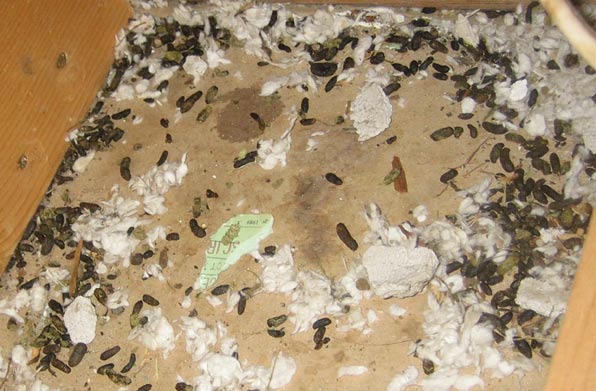
While I've had rats in my apartment walls for quite some time, they don't seem to come inside, so I let them be. In our office, however, it's quite a different matter. They make quite regular appearances, staging late-night races with each other around the second floor, sliding up and down the Internet cables as if it's a fire station in here, and leaving presents* everywhere.
They ate a small cactus I had bought days after I brought it to the office; the other day, I arrived to find they had been nibbling on the soft foam bun-shaped (and scented) keychain my friend had given to me as a present, although I could hardly blame them as every human who passed by it also instinctively held it to his/her mouth. I confess, I also could not resist taking a bite (before the rat did).
Of the four of us who work in here on a regular basis, three of us are, to varying degrees, afraid of coming into contact withe the creatures. So far, we've managed to catch two of them, one with a glue trap (most of the glue-trap attempts failed miserably, catching only fur and feces), which we had to ask the hired cleaners to carry out, and the other after our intern spotted one scramble into the trash can and called our dear designer to come smash it with a stick.
Yesterday, we were having a coffee in a restaurant whose name I shall not mention when I swore I felt something move under the cushion I was sitting on. I decided it must have just been the cushion so I did nothing about it; but then I felt it again and again. After five or ten minutes of this, finally I stood up and proclaimed something was moving under me. One of the girls in the group chimed in, "Yeah, I hear something!"
So we turned to the waiter, who was watching the whole scene, and said, "There's a rat here!"
"有," he replied, affirming our fears.
Naturally we all jumped up and ran to another table.
Not long after, the boss, who we know quite well, came in.
"Hey, you have a rat in here!" we started yelling.
"I know. It opened the fridge the other day and nibbled on the cheese," he replied casually.
"What!? Opened the fridge?" We didn't believe it.
"Really! It did!" And then he went to the back and pulled out a piece of gnawed-on cheese to prove it.
Later I was skeptical. The boss is quite a prankster, and I wouldn't put it past him to carve out a piece of cheese to make it look like a rat had eaten it just so he could tell us that story.
The next day, we were in the office when the boss starts calling my coworker's name.
"What?" he asks.
The boss starts coming up the stairs to the second floor where we work. "Was it him you saw yesterday?" he starts asking.
Just then he comes into view. In his hand, he's got a cage, with a decent-sized rat in it. We all start yeeking and eeewwwing and heebie-jeebie-ing. "Was it him?" the boss asks again, chuckling and pointing at the rat, whose tail and claws are curling out between the bars of the cage.
I like how the boss, owner of a successful, nationwide chain of restaurants and internationally published photographer, is calmly carrying around a cage with a rat in it--even chuckling at it, or us--and planning, he says, to take it out back and drown it in a few moments while we're sitting here freaking out about the idea of a rat being in our presence.
*Thankfully, I have no idea where this photo was taken.
Showing posts with label chengdu. Show all posts
Showing posts with label chengdu. Show all posts
Friday, May 15, 2009



Monday, November 17, 2008
Little Earthquakes and Memories of Shaokao
I awoke this morning, suddenly, after turning in quite early last night, with the lights still on. Seconds later, the room was shaking and the windows rattling. I looked at my cell phone--7 a.m. exactly. I suppose actually the quake started and woke me up, and then I realized it. It registered as 4.8 according to the U.S. Geological Survey's Earthquakes website, and came just 24 1/2 hours after a 4.7 tremor which I did not feel.
Six months almost to the day after the May 12 earthquake, many of us are still somewhat jumpy about shaking and noise that might indicate aftershocks, and apparently for good reason, 'cos they just keep on coming.
In other quake-related news, L.A. just held a drill to prepare for the event of a 7.8-magnitude shake; and in addition to Prince Andrew's recent visit to Sichuan, Donna Versace and Jet Li recently toured the quake site. I spoke with a Vanity Fair Italy writer who was in town to cover the event and get the scoop and got the impression that still, nobody really knows what's going on, and those who do are keeping their mouths shut.
On a completely unrelated note, I just ate some shaokao, a snack consumed usually by late-night partiers due to its omnipresence on Chengdu's streets between the hours of 10 p.m. and 5 a.m., and loved by foreigners for its point-and-choose ease of ordering--sticks of meats, vegetables, tofu, mushrooms, etc. are laid out on the back of a vendor's cart, and customers can come up, choose the sticks they want, and hand them to the vendor, who proceeds to roast them over burning coals, adding oil, salt, pepper, MSG, and Sichuanese spices. I usually eat it about once a month these days because it's never been my favorite, although sometimes, like tonight, it really hits the spot.
Like much of food culture in China, eating shakao is generally a social event, so as I sat on my miniature plastic stool by my lonesome at a shoddy chipboard table, I had nothing to do but reflect on times past--such as the time my then-roommate and co-conspirator Malice stole shaokao from the stand near our former apartment. We had come back late, probably close to sunrise, from the south side of town, and were starving. The only food around there at that time was shaokao, and so we made a beeline for the stand. When we arrived, the sticks were all laid out, but there was nobody to be found. After standing around for a while, shy and unsure about using our limited Chinese, we braced ourselves and tried to call out, the way the locals do when nobody is in sight. We called and called, to no avail. Finally, we grabbed a few sticks of mantou, laid some money on the table, and made a run for it, Malice trying to hold them under her coat lest we run into the wayward shaokao seller on the way. When we got home we collapsed in laughter. Perhaps we were a bit tipsy that night as well. Untoasted, the mantou wasn't very good, either.
Wednesday, October 10, 2007
boxing comes to chengdu

In what seems to be a never-ending slew of international sporting events coming to Chengdu (most notably the FIFA Women's Cup last month), last night brought the World Boxing Association 86th Conference to the Sichuan Stadium.
As we got a hold of ten free tickets, I decided to go to my first professional sporting event in China along with the rest of Team CHENGDOO and some friends.
It was actually pretty fun, although the stadium was half-empty, and the first couple of hours were spent watching ho-hum matches between mostly lightweight male boxers--China vs. France, China vs. China, China vs. Thailand.
But things heated up when the big event of the night--the female super flyweight (115 lbs.) match between China's Zhang Xi Yan and two-time champion Ha Na Kim from Korea--got underway. With fanfare involving flags and national anthems, the ladies came out to the ring, spectators rose to their feet, and the punching began.
While the previous matches--all between men--saw a grand total of one knockout, Zhang had Kim on the floor several times, much to the delight of her fellow Chinese nationals, and most everybody else in the crowd as well.
The match ended with Zhang, not surprisingly, taking the title, after having beaten Kim in every single round.
A nice start for China, who enters the international boxing arena with this groundbreaking event--the first of its kind to be held in the country.
Saturday, September 22, 2007
World Carfree Day, 2007
Um, so somewhere between 100 and 108 of China's cities, including Chengdu, according to Shanghai-based Bloomberg.com reporter Irena Shen, are supposed to be participating in this event--but I didn't notice any decrease in the number of cars this afternoon while I rode my bike to work--or when I looked out the window at quarter past 6 p.m. Hmph.
Crappy China Daily article posted to Xinhua:
BEIJING, Sept. 22 -- Today's Car-Free Day is significant both for China and the rest of the world.
Crappy China Daily article posted to Xinhua:
BEIJING, Sept. 22 -- Today's Car-Free Day is significant both for China and the rest of the world.
It is the first time that 108 Chinese cities will take part in the annual global event, which dates back to the 1950s.
China is an important participant in the campaign. The country became the world's second-largest auto market and third-largest carmaker last year.
It has also become the second-largest greenhouse gas producer in the world, and is rapidly catching up with the United States, the largest emitter.
In this sense, China's participation will greatly strengthen the Car-Free Day movement.
For Chinese, owning a car is a dream that came true only very recently. Passion for car ownership is strong and is gaining momentum all the time. The number of cars on the roads is multiplying almost by the hour.
In Beijing, about 1,000 new cars are added to the streets on an average day. In Shanghai, 8,000 license plates were issued by auction this month. The average price of nearly 50,000 yuan for a plate indicates a fervent demand for cars.
Cars certainly offer motorists plenty of freedom to move around, especially those living in remote areas.
But in many Chinese cities, this convenience has quickly turned into a nightmare, as roads become increasingly gridlocked by the rising number of cars.
An aerial view of Shanghai's elevated highway during rush hour would often look like a gigantic parking lot.
The capital, Beijing, is sometimes referred to as "shoudu" - not the capital, but the nation's most congested city.
So what was designed to offer greater freedom of movement is now inhibiting people's ability to move about freely, instead creating road blocks that slow the movement of the urban population.
This must come as a great surprise to new car owners when they discover that their newfound freedom is in fact the opposite.
More importantly, this obsession with car ownership is unfair to the many people who continue to use urban public transport, which is now also becoming clogged by the increasing number of cars.
Even worse is the environmental impact. A State Environmental Protection Administration report says that on a "smog day," 79 percent of the air pollution is caused by car fumes.
According to experts, the discharge of harmful car exhausts will be reduced by 3,000 tons on Car-Free Day. These fumes threaten people's lives by damaging the respiratory system - particularly the lungs. They also cause cancer and deteriorate heart disease.
The growing number of traffic accidents is another threat. China's annual death toll of 100,000 from traffic accidents is by far the highest in the world.
While Car-Free Day in Beijing got a lukewarm response two years ago, the keen participation of 108 cities this year shows growing public concern about the traffic and environmental problems caused by cars.
Today, all cars will be barred from selected areas in these 108 cities. People will be encouraged to walk, cycle and use public transport.
A massive week-long campaign promoting the use of public transport started in all of these cities on September 16. Many government officials have also pledged their support by vowing to use only public transport.
Compared with cars, public transport like buses and the subway network are a cleaner, more economical and safer alternative.
Cycling and walking are the healthier options. Exercise not only delays the aging of the brain, but also enhances the function of the heart and lungs, as well as strengthening muscles and increasing fitness.
But emissions from the rising number of cars on the roads are affecting the air quality of cyclists and pedestrians.
Local governments haven't helped the situation by expanding car lanes and shrinking or even eliminating bike lanes and footpaths.
That policy has clearly failed. It sends the wrong message by inviting more people to buy cars. So even with widened roads, traffic congestion has become worse than ever before in most Chinese cities.
By favoring drivers, this policy has discriminated against the vast number of cyclists and pedestrians.
Hopefully, today's Car-Free Day will be an awakening for all the local governments that are still making or carrying out these policies.
In Shanghai, the government has switched its emphasis to public transport by designating more bus lanes. Discounts are also being offered for transfers to the city's public transport system.
Some 400 kilometers of subway network is expected to be operational by 2010. This mass transit system aims to make driving a car less necessary in Shanghai.
Shanghai is also reportedly considering introducing a congestion charge in the city center to relieve both the hazards from traffic congestion and air pollution.
As excessive numbers of cars choke up cities and make them less inhabitable, the pledge by 108 Chinese cities to the world to free the streets of cars for a day is just the beginning of the battle.
With cleaner air and smoother traffic in these 108 Chinese cities for a day, more cities will hopefully want to join the campaign next year. And if that happens, it may trigger a shift in thinking; more people might share the hope that Car-Free Day is not just on Sept. 22, but a possibility 365 days of the year.
(Source: China Daily)
| Editor: Du Guodong |
Friday, September 14, 2007
Choice Quote on Driving
"I believe that while there are many reasons for the growth of individualism in the UK, the extreme libertarianism now beginning to take hold here begins on the road. When you drive, society becomes an obstacle. Pedestrians, bicycles, traffic calming, speed limits, the law: all become a nuisance to be wished away. The more you drive, the more bloody-minded and individualistic you become. The car is slowly turning us, like the Americans and the Australians, into a nation that recognises only the freedom to act, and not the freedom from the consequences of other people's actions. We drive on the left in Britain, but we are being driven to the right."
-- George Monbiot, "They call themselves libertarians; I think they're antisocial bastards," The Guardian, Tuesday December 20, 2005
Also, my own experience at intersections in China (a response to a discussion on the "shared space" traffic concept):
I currently live in Chengdu (pop. somewhere around 10 million) and have visited many of the nation's other large cities. For whatever reason (my conjecture is the relatively recent introduction of the automobile to the masses), traffic lights here are regularly ignored by rivers, pedestrians, and bikers. At intersections, whichever group is the greatest in number seems to just go; and it is a nice contrast to crossing the street in my former haunts of Los Angeles, where was often the lone pedestrian against a street full of cars, to feel that those great hordes of us on foot/bike are taking (back) the streets from automobiles. On the flip side, we can never assume we have the right of way; that right is almost always taken by drivers. Of course all this is changing, with increasing numbers of cars on the street every day, and more and more uniformed traffic guards at all four corners of major intersections, armed with whistles (though not much else), waving at bikers and pedestrians to stay behind the lines when their light is red. This, too, seems to be a re-engineering of social mentality to conform to cars: Those of us on foot/bike need to yield to car drivers for our own safety while they are generally free to do as they please, including driving down bike lines that are separated from the normal driving lanes by cement barriers.
And lastly, a quote oft-attributed to Margaret Thatcher, though that's disputed by at least one source:
“A man who, beyond the age of 26, finds himself on a bus can count himself a failure.”
-- George Monbiot, "They call themselves libertarians; I think they're antisocial bastards," The Guardian, Tuesday December 20, 2005
Also, my own experience at intersections in China (a response to a discussion on the "shared space" traffic concept):
I currently live in Chengdu (pop. somewhere around 10 million) and have visited many of the nation's other large cities. For whatever reason (my conjecture is the relatively recent introduction of the automobile to the masses), traffic lights here are regularly ignored by rivers, pedestrians, and bikers. At intersections, whichever group is the greatest in number seems to just go; and it is a nice contrast to crossing the street in my former haunts of Los Angeles, where was often the lone pedestrian against a street full of cars, to feel that those great hordes of us on foot/bike are taking (back) the streets from automobiles. On the flip side, we can never assume we have the right of way; that right is almost always taken by drivers. Of course all this is changing, with increasing numbers of cars on the street every day, and more and more uniformed traffic guards at all four corners of major intersections, armed with whistles (though not much else), waving at bikers and pedestrians to stay behind the lines when their light is red. This, too, seems to be a re-engineering of social mentality to conform to cars: Those of us on foot/bike need to yield to car drivers for our own safety while they are generally free to do as they please, including driving down bike lines that are separated from the normal driving lanes by cement barriers.
And lastly, a quote oft-attributed to Margaret Thatcher, though that's disputed by at least one source:
“A man who, beyond the age of 26, finds himself on a bus can count himself a failure.”
Tuesday, August 14, 2007
Chinese Tea Snobs
Last Sunday was one of those very rare sunny days in Chengdu, so I decided to honor my eighth-grade language-arts teacher, who signed my yearbook "carpe diem--that's what comes to mind when I think of you" (or something to that effect) by seizing the day and taking photos.
When the sun's out, Chengdu is actually not a bad place to find interesting images. I've run through two-and-a-half rolls of 36-exposure film in the last few days, which is about as much as I've shot in my previous three years in China combined. Plus I've gotten over a lot of my initial self-consciousness holding up a camera to my face (in hopes of avoiding perpetuating the rich foreign tourist stereotype). The only question now is where I can develop and make prints of black-and-white film properly.
My goal was to get some shots of Tianfu Plaza, the downtown square which was just re-opened this past February after several years' closure. (These aren't my photos; just a representative sample from a random search.) When I moved to Chengdu two years ago, it was a giant dirt pit. That hole has now been replaced by a spectacular above-ground plaza that will be the site of the main subway station, the first line of which will open in a year or two.
Upon finishing, after detouring through the fish and flower market (of which I'd long heard but had never been) as well as a street where most of the houses are still brick and you can look between the rows into alleys where residents have strung their laundry on bamboo poles--to be disappearing shortly, I'm sure, I turned down the main road heading to my apartment. On the corner there's a tea shop where I once purchased some Chinese black tea, which, incidentally, is called red tea in Chinese.
When I bought the tea of course I was invited to have a seat and sample it, and I spent some time chatting with the two employees there. The woman is 24 and from a central/eastern province; the man is older. As they sit in the tea shop all day other than when they run errands, I'm guessing they don't have much to do other than to drink tea. So when I pass by I try to make sure to look in, and if they happen to be gazing out the window I'll wave. This time the girl didn't see me until I was almost already past, and when she realized I was waving at her, she jumped up and beckoned me to come inside a sit for a moment.
As it was a meandering Sunday, I agreed, and she immediately started preparing the tea. It's a fairly elaborate process: First she sets down a tiny tray in front of me; then, from a pot of boiling water fishes out a cup about the size of a single shot glass and sets it on the tray. Next, she pours hot water through a filter into a tiny teapot that's filled with tea leaves. This water is then poured into another tea pot, and finally poured all over the main tea tray, which has a drain in the bottom. She refills the original teapot, repeats the process, and finally my cup is filled, and I can drink this second steeping of the tea. While she goes through this I stare at the paper-wrapped bricks or cakes of tea leaves behind her head, most of which come from Yunnan province (just south of here and also China's largest coffee producer), some of which are discs about 10" in diameter and go for a few hundred RMB.
That day the other employee came back with a new supply of Oolong tea leaves, which were promptly dug into for sampling. This demanded my little tray hold two tiny cups, as we tried three different batches, each one progressively better, from what I could deduce. To me, they all tasted, to varying intensities, like artichoke. My limited knowledge of tea terminology in Chinese precluded me from catching all the details of the discussion, but there was much debate over not only the taste, but also the smell of the tea (which seems crucial), as well as the change in leaves from dry to wet and the change in the color of water over a series of steepings. The boss of the tea shop also stopped by and gave his expert opinion--I guess. At any rate, I drank so much tea I started feeling sick so eventually I excused myself because if I didn't I was going to have to keep on drinking ... .
In other news, I've got exactly 17 days until my visa expires, and no definite plan about what to do about that. Tomorrow afternoon I'll find out if I can avoid having to go to Hong Kong, which would be nice.
And I've recorded a Chinese-learning radio show with a CHENGDOO citylife editorial assistant, Annie. If you care to listen, it's on her blog here. I made one stupid and embarrassing mistake, but the rest is OK I guess.
When the sun's out, Chengdu is actually not a bad place to find interesting images. I've run through two-and-a-half rolls of 36-exposure film in the last few days, which is about as much as I've shot in my previous three years in China combined. Plus I've gotten over a lot of my initial self-consciousness holding up a camera to my face (in hopes of avoiding perpetuating the rich foreign tourist stereotype). The only question now is where I can develop and make prints of black-and-white film properly.
My goal was to get some shots of Tianfu Plaza, the downtown square which was just re-opened this past February after several years' closure. (These aren't my photos; just a representative sample from a random search.) When I moved to Chengdu two years ago, it was a giant dirt pit. That hole has now been replaced by a spectacular above-ground plaza that will be the site of the main subway station, the first line of which will open in a year or two.
Upon finishing, after detouring through the fish and flower market (of which I'd long heard but had never been) as well as a street where most of the houses are still brick and you can look between the rows into alleys where residents have strung their laundry on bamboo poles--to be disappearing shortly, I'm sure, I turned down the main road heading to my apartment. On the corner there's a tea shop where I once purchased some Chinese black tea, which, incidentally, is called red tea in Chinese.
When I bought the tea of course I was invited to have a seat and sample it, and I spent some time chatting with the two employees there. The woman is 24 and from a central/eastern province; the man is older. As they sit in the tea shop all day other than when they run errands, I'm guessing they don't have much to do other than to drink tea. So when I pass by I try to make sure to look in, and if they happen to be gazing out the window I'll wave. This time the girl didn't see me until I was almost already past, and when she realized I was waving at her, she jumped up and beckoned me to come inside a sit for a moment.
As it was a meandering Sunday, I agreed, and she immediately started preparing the tea. It's a fairly elaborate process: First she sets down a tiny tray in front of me; then, from a pot of boiling water fishes out a cup about the size of a single shot glass and sets it on the tray. Next, she pours hot water through a filter into a tiny teapot that's filled with tea leaves. This water is then poured into another tea pot, and finally poured all over the main tea tray, which has a drain in the bottom. She refills the original teapot, repeats the process, and finally my cup is filled, and I can drink this second steeping of the tea. While she goes through this I stare at the paper-wrapped bricks or cakes of tea leaves behind her head, most of which come from Yunnan province (just south of here and also China's largest coffee producer), some of which are discs about 10" in diameter and go for a few hundred RMB.
That day the other employee came back with a new supply of Oolong tea leaves, which were promptly dug into for sampling. This demanded my little tray hold two tiny cups, as we tried three different batches, each one progressively better, from what I could deduce. To me, they all tasted, to varying intensities, like artichoke. My limited knowledge of tea terminology in Chinese precluded me from catching all the details of the discussion, but there was much debate over not only the taste, but also the smell of the tea (which seems crucial), as well as the change in leaves from dry to wet and the change in the color of water over a series of steepings. The boss of the tea shop also stopped by and gave his expert opinion--I guess. At any rate, I drank so much tea I started feeling sick so eventually I excused myself because if I didn't I was going to have to keep on drinking ... .
In other news, I've got exactly 17 days until my visa expires, and no definite plan about what to do about that. Tomorrow afternoon I'll find out if I can avoid having to go to Hong Kong, which would be nice.
And I've recorded a Chinese-learning radio show with a CHENGDOO citylife editorial assistant, Annie. If you care to listen, it's on her blog here. I made one stupid and embarrassing mistake, but the rest is OK I guess.
Wednesday, July 25, 2007
A Tale of Two Cities
I was in a cab on the way home, thinking how I really ought to just break down and buy a bike, when I started thinking about why it is in Chengdu I've only ever been driven by one female cabbie whereas in Suzhou and Shanghai they were commonplace. Is it something about that Shanghai/Jiangsu culture of "soft men" that allows women to more easily enter traditionally male-dominated professions? Or is it simply more demand for more jobs that sends everybody--men and women--scrambling for more work?
On the other hand, female bus drivers are commonplace in both Chengdu and Suzhou--in fact, I feel like there might even be more female bus drivers than male. In Los Angeles, this might also have been true, but I never encountered a female cabbie there or elsewhere in the States, though, granted, I rarely encountered cabs, period.
It would be interesting to know what the comparison is like in other cities--thinking back, of all the cabs I remember taking in cities like Shenzhen, Guangzhou, Beijing, Wuhan, Hong Kong ... all the cabbies were men, but I took very few cabs in each of those cities.
On the other hand, female bus drivers are commonplace in both Chengdu and Suzhou--in fact, I feel like there might even be more female bus drivers than male. In Los Angeles, this might also have been true, but I never encountered a female cabbie there or elsewhere in the States, though, granted, I rarely encountered cabs, period.
It would be interesting to know what the comparison is like in other cities--thinking back, of all the cabs I remember taking in cities like Shenzhen, Guangzhou, Beijing, Wuhan, Hong Kong ... all the cabbies were men, but I took very few cabs in each of those cities.
Sunday, July 22, 2007
"Oh yeah, sorry"
Last night I went out of my apartment for the first time all week save for food runs and plain old runs. I started at the 麻糖/Hemp House, where there was a hip-hop DJ show, which turned out to be pretty dry. However, I did run into one of the owners of beloved French bar 巴黎咖啡/Cafe Panam(e), who asked if I wanted to check out a bar that was opening that night with him.
The grand opening of 巴黎魔术/Paris Magic Bar had been minimally hyped and sounded from the descriptions like some sort of hokey weird gimmicky thing (alcohol + magic shows = ???), so I had skipped the show. We arrived there around 1 a.m., when most people had already left. When I started having some serious trouble understanding the French-accented slurring that was coming out of my friend's mouth, I realized he was pretty drunk; then, when a few what-appeared-to-be Northerners swaggered in, they greeted him (I guess as the owner of a bar, you're pretty high-profile), and he came back to me and said, "Hey, Chinese people talking to me in perfect English--American or Canadian, I do not distinguish accents--more fluent than mine!"
I looked at him and said, "Maybe they're not Chinese."
He looked at me and said, "Oh yeah. Sorry."
A few beers later, upon my raised-glass-toasting gesture, he says, "Hey, you're becoming Chinese."
"Dude, I am Chinese," I said.
He looked at me again. "Oh yeah. Sorry." Pause. "I'm Polish!"
At any rate, the bar was actually a cozy little spot, and it's right smack in the middle of what can only be described as a dance-club emporium featuring the ever-popular BABI II as well as Sugar and TaTa, which attract clubgoers into the whee hours of the morning, so I could see it becoming a nice chilling spot for those who are too tired to keep shaking their booties. Unfortunately, the bar owner/magician is no spring chicken, and by 4 a.m. on his first night in business he was already passing out on the couches. I hope he pays his employees well.
The grand opening of 巴黎魔术/Paris Magic Bar had been minimally hyped and sounded from the descriptions like some sort of hokey weird gimmicky thing (alcohol + magic shows = ???), so I had skipped the show. We arrived there around 1 a.m., when most people had already left. When I started having some serious trouble understanding the French-accented slurring that was coming out of my friend's mouth, I realized he was pretty drunk; then, when a few what-appeared-to-be Northerners swaggered in, they greeted him (I guess as the owner of a bar, you're pretty high-profile), and he came back to me and said, "Hey, Chinese people talking to me in perfect English--American or Canadian, I do not distinguish accents--more fluent than mine!"
I looked at him and said, "Maybe they're not Chinese."
He looked at me and said, "Oh yeah. Sorry."
A few beers later, upon my raised-glass-toasting gesture, he says, "Hey, you're becoming Chinese."
"Dude, I am Chinese," I said.
He looked at me again. "Oh yeah. Sorry." Pause. "I'm Polish!"
At any rate, the bar was actually a cozy little spot, and it's right smack in the middle of what can only be described as a dance-club emporium featuring the ever-popular BABI II as well as Sugar and TaTa, which attract clubgoers into the whee hours of the morning, so I could see it becoming a nice chilling spot for those who are too tired to keep shaking their booties. Unfortunately, the bar owner/magician is no spring chicken, and by 4 a.m. on his first night in business he was already passing out on the couches. I hope he pays his employees well.
Friday, June 29, 2007
Once-a-Year Drenching Has Passed for '07
I tried to go for a run last night, only to be caught up in what has probably been Chengdu's heaviest storm to date this season. It seems inevitable that once a year, everybody's going to be caught in one of these--last year it was on my way to teach classes, and I was on the bus when it started pouring, and when I had to get off it hadn't let up at all; all three of us foreign teachers were drenched to the bone. Yesterday was my turn for this year.
I figured, when it started drizzling, that there would be a chance the rain would get heavier, but I persisted running around the track anyway. Along with the rain drops, which, with the heat and my running, didn't feel very cold anyway, came plenty of thunder and lightning, which, thanks to this article, was causing me some concern. As the drops grew more frequent, I finally decided to head home, and I was walking through campus when buckets just started pouring out of the sky. I've only witnessed this in L.A. once, but it seems to happen in Chengdu (and also Bangkok) with some regularity. I sought cover under a building overhang, while everybody else--who all seemed prepared with umbrellas--ran around screaming and hailing cabs. I figured I could hang out under the overhang for a while until it lightened up, given that all I was wearing was a white T-shirt and running shorts, when suddenly an empty cab appeared! Hallelujah! An empty cab in the rain is a rare thing indeed. Figuring it was then or never, I ran out into the rain, completely soaking myself in the process. The driver looked at me, slowed down for a second, and kept on driving.
Figuring that I was already drenched to the bone, I might as well keep going, so I made the ten-minute walk out to the bus stop, being poured on and wading through puddles that were five or six inches deep in some places. I got to the bus stop and stood there, wringing out my shirt and trying to look nonchalant.
The weather here is wack, and this entry is totally banal.
I figured, when it started drizzling, that there would be a chance the rain would get heavier, but I persisted running around the track anyway. Along with the rain drops, which, with the heat and my running, didn't feel very cold anyway, came plenty of thunder and lightning, which, thanks to this article, was causing me some concern. As the drops grew more frequent, I finally decided to head home, and I was walking through campus when buckets just started pouring out of the sky. I've only witnessed this in L.A. once, but it seems to happen in Chengdu (and also Bangkok) with some regularity. I sought cover under a building overhang, while everybody else--who all seemed prepared with umbrellas--ran around screaming and hailing cabs. I figured I could hang out under the overhang for a while until it lightened up, given that all I was wearing was a white T-shirt and running shorts, when suddenly an empty cab appeared! Hallelujah! An empty cab in the rain is a rare thing indeed. Figuring it was then or never, I ran out into the rain, completely soaking myself in the process. The driver looked at me, slowed down for a second, and kept on driving.
Figuring that I was already drenched to the bone, I might as well keep going, so I made the ten-minute walk out to the bus stop, being poured on and wading through puddles that were five or six inches deep in some places. I got to the bus stop and stood there, wringing out my shirt and trying to look nonchalant.
The weather here is wack, and this entry is totally banal.
Subscribe to:
Posts (Atom)